
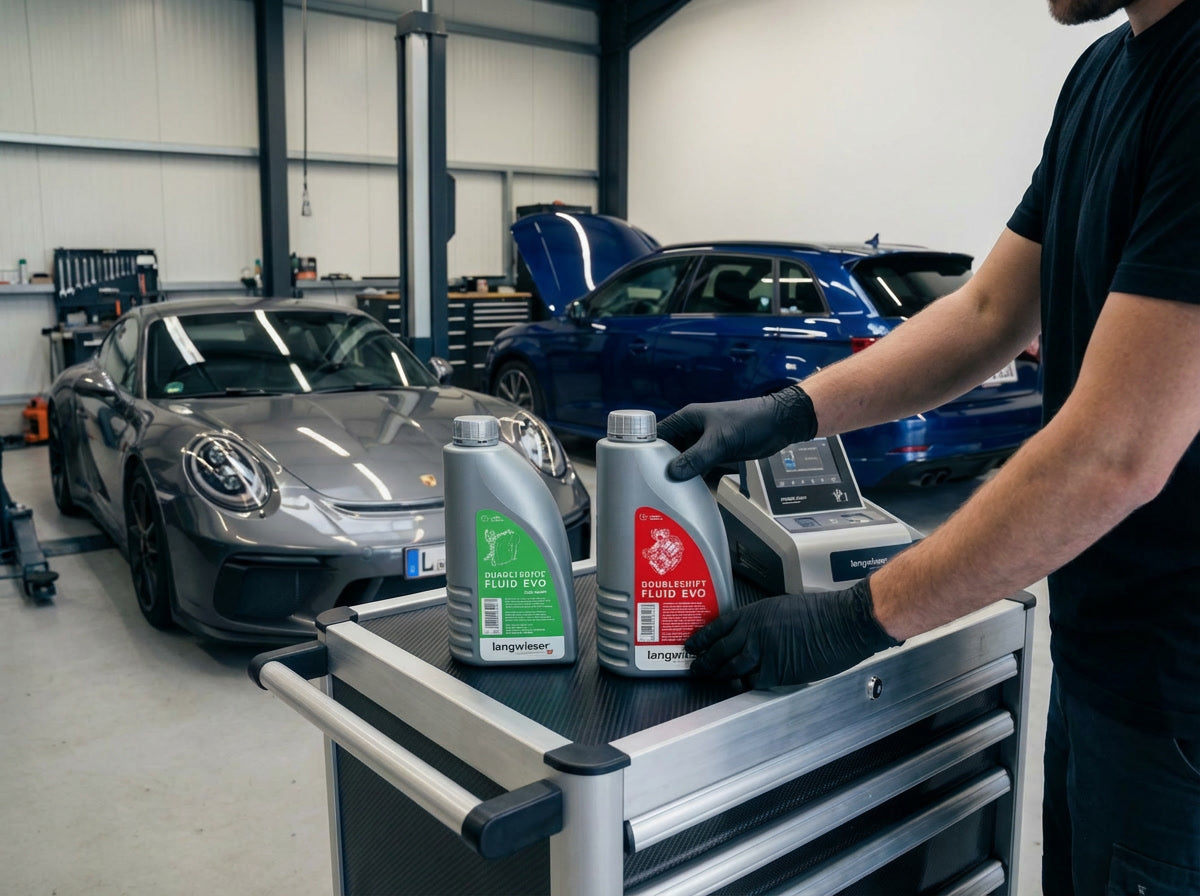
Anyone who loves their car and values performance knows that not all oils are created equal. The requirements for lubricants are extremely specific, particularly within the VAG Group (VW, Audi, SEAT, Skoda) and at Porsche. Using the wrong oil can not only reduce efficiency but, in the worst case, cause costly damage to the transmission or engine.
In this guide, you’ll learn all about the most important standards, why reference numbers are your best friend, and which container sizes make the most sense for you.
1. The Jungle of Oil Standards: What’s Behind Them?
Oil standards are essentially the “rulebook” for your vehicle. They define exactly which chemical and physical properties an oil must meet.
The VAG Focus (G Numbers)
At Volkswagen and Audi, you’ll often come across what are known as G-numbers.
- G 052 182 / G 052 529: These are standard numbers for DSG transmissions (dual-clutch transmissions). Since these transmissions shift extremely quickly and must handle high thermal loads, strict compliance with this standard is crucial.
- G 055 529 / G 052 536 / G 055 536: These are often used in special high-performance or all-wheel-drive components.
The Porsche Standard (PDK)
Porsche uses its own part numbers, which often exist in parallel with VAG standards but undergo more rigorous testing:
-
Reference 999.917.080.01 / 999.917.080.00: This is a typical designation for high-performance oils, which often correspond to the FFL-3 standard. FFL-3 is the magic word for many modern dual-clutch transmissions (PDK) at Porsche.
2. Mechatronics & Hydraulics: The Control Center
Mechatronics is an area that is often underestimated (e.g., in the DQ200 7-speed DSG). Here, a separate hydraulic circuit - isolated from the mechanical transmission fluid - is in operation. The fluid must be extremely low-viscosity in order to control the fine valves at lightning speed.
Important Hydraulic Part Numbers:
- VAG Part Number: G 004 000 M2 / G 002 000 (VW Standard TL 52 146)
- Porsche Part Number: 000 043 204 89
3. The package code: What do “A2” or “M2” mean?
After every original reference number, you’ll find a suffix that indicates the package size. This is crucial for your calculations:
| Suffix | Meaning | Typical Application |
| …A2 / …M2 | 1.0-liter bottle | The standard for servicing mechatronics, DSG, or for topping up. |
| …A1 | 0.5-liter container | Ideal for small adjustments to the fluid level. |
| …A6 / …M6 | 20-liter canister |
For professionals, complete transmission flushes, or track teams. |
4. Why the Exact Part Number Is Essential
At Langwieser Performance, we insist on strict adherence to the manufacturer’s part numbers.
The correct part number guarantees:
- Precise friction coefficients: No slipping or “jerking” of the clutches in DSG, S-Tronic, and PDK transmissions.
- Seal protection: Prevents sensitive mechatronic seals from swelling or becoming brittle.
-
Wear protection: Optimal value retention and protection against costly transmission damage in everyday use.
Conclusion: Check first, then fill
The reference number is your guide. Only an exact match will ensure your vehicle’s long-term performance. Not sure which number is right for your project? The team at Langwieser Performance is here to provide expert advice.